
Meet a Medievalist Maker: Mearcstapan
“Meet a Medievalist Maker” is an ongoing series of blog posts introducing our members and the work they are doing. Each post is organized around our Four P’s: a project they are working on (or have completed but want to highlight); their process: medium, etc; a peek at their work: images or excerpt; and a prompt: instructions for a brief exercise they share to allow readers to experience/explore their process. Would you like to write a post introducing yourself and your work? Send us an email!
Project
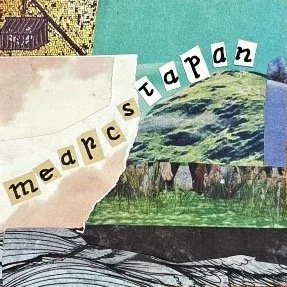
Wesaþ hāle! We’re Ella O’Shea (she/her) and Issi Marklew (she/her), undergraduate English students at Oxford and co-founders of Mearcstapan, a student-led medieval society dedicated to creative, critical, and collaborative approaches to the medieval world.
Beginning university was a massively daunting experience for us both and beginning study of the medieval — something that felt so foreign and distant from us — felt even more so. For many of us with marginalised identities, even when we have started our studies, this feeling of otherness doesn’t go away when our university curricula only represent a small portion of medieval stories. Yet, thanks to tutors who were passionate about making medieval study accessible and inclusive, we discovered the richness, diversity and magic of the medieval, and fell completely in love with it. And we wanted to share that with our peers! Thus, Mearcstapan was born in February 2026.
‘Mearcstapan’ is an Old English compound found in Beowulf, translating to ‘boundary-walker’, and felt a fitting title for our endeavour. It is used to describe the Grendelkin who literally and figuratively walk in the margins of their landscapes, navigating the border between Heorot and the fens, between humanity and monstrosity, between prominence and obscurity. We felt drawn to this description and how it related to our own identities, as well as our interests in marginalised medievalism.
As students, we occupy intersections: in our identities, of race, gender, religion, disability, sexuality, and social class, and as undergraduates, living on the cusp between amateur and academic. We wanted to create a place where we didn’t have to be either/or in our identities or push them down. Through our studies, we learned that our unique identities are inextricably intertwined with our academic output, and can be a source of strength. They can be starting points for new, untrodden academic paths.
Walking the shores of the mere can be isolating, perpetually pushed out of the hall. Through our wonderful community of students, tutors, and the medievalist family that has welcomed us, we’ve instead made a home on the boundary, navigating the borderlands not out of necessity but by choice to accept all parts of ourselves, and all parts of medieval study — even when uncomfortable or impolite. By breaking boundaries, and representing medieval scholarship not as formidable or exclusionary, but instead as something for everyone, we hope Mearcstapan is becoming a community where people can feel represented and empowered.
Peek
With minimal resources thus far, but a crack team of Mearcstapan student organisers, we have been running weekly events in Oxford term-times. We have been incredibly lucky to have wonderful Oxford medievalist academics deliver talks on subjects often underrepresented on university syllabi, such as the Global Middle Ages, gender and humour, or cognitive/neurodiversity studies.
We have also been putting on events which introduce new, inclusive and accessible modes of medievalism, particularly creative criticism; these have included a Creative-Critical Your Revision session, and Scop and Sip (an oral storytelling/poetry open mic night). Sometimes accessibility and inclusion for new medieval voices also just means making sure they’re thoroughly welfared! We have had medievalist film nights (Monty Python and the Holy Grail, and the infamous 2007 Beowulf), and our termly BeoWulfare Week Crafts is a true Mearcstapan staple. We also regularly terrorise our Instagram followers’ Stories with medieval memes (@mearcstapan).
Our biggest project to date, which Mearcstapan undertook last term, was the inaugural launch of our magazine, The WordHoard. This was a creative-critical labour of love, set up due to popular demand from the Mearcstapan masses to showcase the work of our peers and give us a space to talk about what interests us in the world of the medieval.
We were overwhelmed by the response – we came in expecting a zine with a few contributors, and came out with a 50-page magazine, boasting contributors diverse in disciplines, levels of study, topics, identities and approaches. This included, to name just a few pieces, comparative writing on Classical Chinese and Old English elegaic poetry with hand-drawn illustrations, a knitted piece inspired by Wulf and Eadwacer, discussion of modern medievalist retellings of Sufi writing, an Old English-style poem from the point of view of an abandoned building, and an autistic reading of the Grendelkin’s ‘monstrosity’.
We celebrated its launch with a big collective picnic in University Parks at the end of Trinity Term, which was such a joyous occasion. All our 50 copies went in under 24 hours, and we had people already asking when we were going to make another! When the future of the humanities so often feels uncertain, holding this magazine and feeling the drive, passion, effort and beauty our contributors and editors poured into it gives us a lot of hope.
We’ve included a PDF of this first edition of The WordHoard for you to read, if you would like! Download The Wordhoard here. It has been split into six parts because of the large file size.
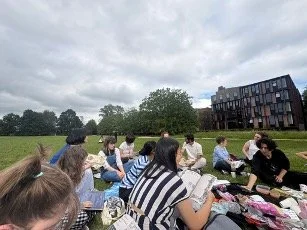
The Mearcstapan Picnic
Process
So many of us undergraduates love all things medieval and might have specific passions we want to kindle already – but many spaces like seminars or academic conferences that allow access to ‘more medieval’ can be inaccessible. If you aren’t well-versed in the social codes and expectations of academia, may not fit the traditional image of an attendee, or may be the youngest or least experienced person in the room, it can be hard to walk into those rooms and feel comfortable in them, let alone the steep price of many conference tickets that even preclude us being there at all. This sadly means we often miss out on enrichment opportunities that can hugely help our process as students!
There are some wonderful, accessible seminars and conferences out there (can confirm!), but free spaces like Mearcstapan can be such a godsend, letting us both explore our interests, network, gain new knowledge and not feel like the odd ones out. Building these community spaces is especially important for those of us interested in marginalised medievalisms, who may lack academic ancestors, or who may unfortunately be met with reticence or dismissal when sharing our ideas. For us, organising Mearcstapan has been so helpful in strengthening our own personal academic identities; we now feel so more confident in our own voices and critical interests in a way we really didn’t just a year ago.
Mearcstapan’s opportunities for creative-critical work have also been so helpful in helping us ‘think with our hands’ as students, especially for those of us who struggle with traditional academic formats due to things like disability. For example, when we made and edited The WordHoard, we wanted to incorporate manuscript layout features into the design, such as framing, marginalia, rubrication and even a scribal colophon. In the process of its creation, then, we embodied medieval scribes and the concerns they would have had when making texts (though in Canva!). You don’t get that kind of knowledge from simply reading about medieval scribal practice!
Prompt
Part of Mearcstapan is encouraging and empowering our members into having the confidence to engage in these practices, as well as giving them space to. Disregard thoughts like “people like me don’t belong in this space”, or “I’m not creative enough”. Instead, ask how does your identity inform your scholarly practice? How could creative practices illuminate your academic process? How can you make space for sidelined perspectives in your work?
If you’re a student…
How can you incorporate marginalised medievalism into your study? Where possible, seek out resources that lie outside of the Western canon, or bring in critical lenses from other areas of your work. Don’t be afraid of following unconventional ways of approaching your work!
Challenge your typical processes of studying! How can you utilise creative practices to enhance understanding? University involves a lot of self-study, and the way you work is just as important as what. When revising, how can you utilise creative-critical processes to see things in a different way? Do you learn best through tactility and movement? If so, embrace that!
If you’re a tutor…
How can you broaden your curricula to be more inclusive? There are growing resources on pedagogy and the marginalised Middle Ages; seek these out and incorporate them into your teaching. Encourage your students to look beyond typical academic paths and empower them to tap into under-researched areas. Instead of fearing their misalignment with rubrics, teach and support your students to engage with these fields in a way that stands up in typical scholarly spaces.
If you’re inspired by the Mearcstapan model…
Start your own version! In true mearcstapa [boundary-walker] style, you don’t need to start with constitutions or paperwork, just put out a call for like-minded individuals and see what happens! Create the events you want to see, and be the community you want to be part of.
Our Instagram: @mearcstapan
Email: mearcstapan@proton.me
Website: The Mearcstackan Substack
