
Meet a Medievalist Maker: Clare Mulley
“Meet a Medievalist Maker” is an ongoing series of blog posts introducing our members and the work they are doing. Each post is organized around our Four P’s: a project they are working on (or have completed but want to highlight); their process: medium, etc; a peek at their work: images or excerpt; and a prompt: instructions for a brief exercise they share to allow readers to experience/explore their process. Would you like to write a post introducing yourself and your work? Send us an email!
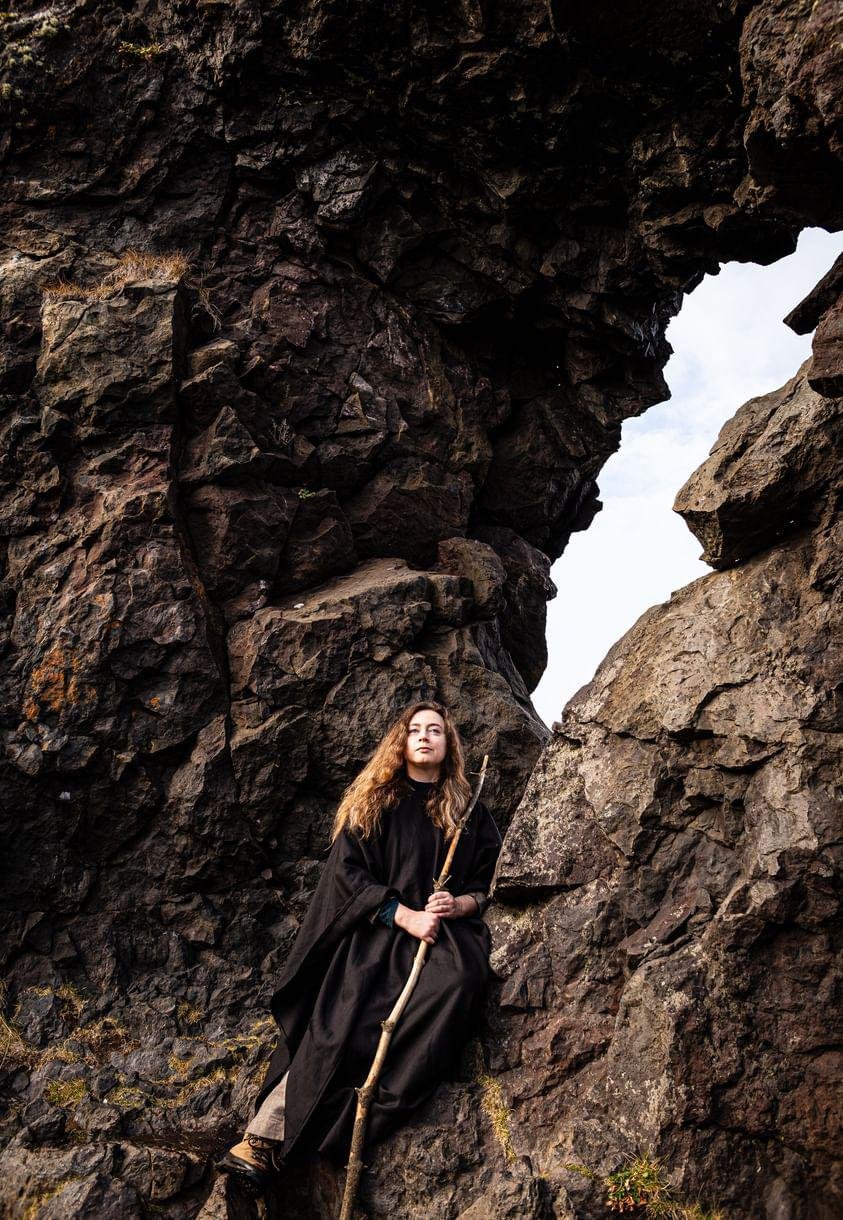
Hi! My name is Clare, and I’m a poet and performer, an Old Norse specialist and a tutor in Old English at St Edmund Hall, Oxford. Although I’ve been writing and leading creative writing workshops since my early twenties, I became a medievalist over a decade later, and totally unexpectedly. It began when I was working as a librarian at a school in London; something I intended as an earner while I developed my writing, and eventually did my MA (specialising in poetry) at Royal Holloway. I definitely preferred telling children stories and reading the books to my other duties! However, my time there also led to my academic interests: the school used to be the Chelsea public library, and so the library room was huge and contained a full collection, some of which was very old. I began reading children’s historical novels on my break and noticed a huge number of works were about Vikings and Old Norse mythology. This intrigued me, as I knew very little then about the Victorian and turn-of-the-century craze for Nordic fantasy. By that time, I had already fallen in love with Byatt’s retelling of Norse mythology in Ragnarok, and read the Poetic Edda in translation; soon I was sufficiently obsessed by the modern obsession with Old Norse that I applied for a DPhil at Oxford, examining how twentieth-century women writers have harnessed the stories to feel a sense of their own identity and power.
Process
By the time I got to Oxford, I was already practising what I researched and writing material based on Old Norse literature. I wrote both original poetry and creative translations which spoke to real-life situations or feelings. I have no specific process for writing a poem; just a way of gathering impressions in my head, letting them percolate and later writing in a stream of consciousness to see what comes out. Structure is generally an afterthought. Most of my works start with a story that stays with me (myth and folklore about uncanny women are my bag) and/or a location - sometimes both converge in very interesting ways. I was recently in Whitby, leading a workshop at the abbey ruins as part of a wider project with Oxford University and English Heritage, and found myself writing about William Scoresby (who grew up on that coastline), and the links between Whitby and whaling. Wooden containers (pulpits, crow’s nests and coffins) formed the solid element of the poem. I write a lot of poems about trolls at the moment, too - something about their uncanny, antisocial quality is extremely freeing.
I began my formal research into The Poetic Edda as a background for my thesis, but, ironically, I had begun examining it creatively long before I began to study it academically. I like to listen to the emotional potential behind the voices; many of them feel ritualistic or like a folk game, and they are great to say aloud. Although gnomic poetry like Hávámal is a pleasure to read for its own sake, my favourite Eddic poems are ones with prophetic voices which recite lore on creation; the poem Völuspá (which I have had the privilege to read from the original, very battered manuscript) is one such work, and is arguably the one which sparks most interest today because of its female narrator. The speaker is a völva (seeress) who offers a vision of the birth, death and rebirth of the cosmos, on behalf of Odin. When I read it for the first time, I was immediately struck by the rhythmic power of its refrains, and the authority of the voice. As a poem which hovers in a permanent state of ‘about-to-happen’, predicting a world on fire and flooding, it is especially pertinent to tensions today. Instinctively, I began a creative translation, to make it fit my own style of delivery. Soon, by the nature of the beast, the poem began to wander off the page; it felt natural and right to speak the words out loud.
This led to another idea. Aside from the powerful speakers and sense of drama, what interests me most about Eddic poetry is that we have very little notion of authorship, and there is every sign that the material came from a wider, performative pool of narrative material. If we consider it in this light, and not simply as set products in manuscript form, the canon takes on a malleable, almost organic quality, like a network of cells that keep self-replicating. Like most medieval literature, the Eddas are part of a vast continuum of works - anyone can tune in, anyone can develop the material in a way that resonates within their own context, and it is likely that many people would have been inspired to produce versions that were never recorded. I realised I was not only responding creatively to Völuspá, but that I could use my own performance of the poem to model the potential for its variability across time, and the hypothetical versions now lost.
Project
My main current project, which is still ongoing, is a staged solo version of my creative translation of Völuspá, which I love doing. It has so far been staged at Oxford, in Aarhus, Denmark, and in the Anglo-Saxon mead hall at Butser Ancient Farm in Hampshire. On an artistic level, it is designed to showcase the ongoing power and relevance of the poem, but every rendition also provides me with research data, which I can use. I am hoping to perform it in Iceland soon but am always open to suggestions!
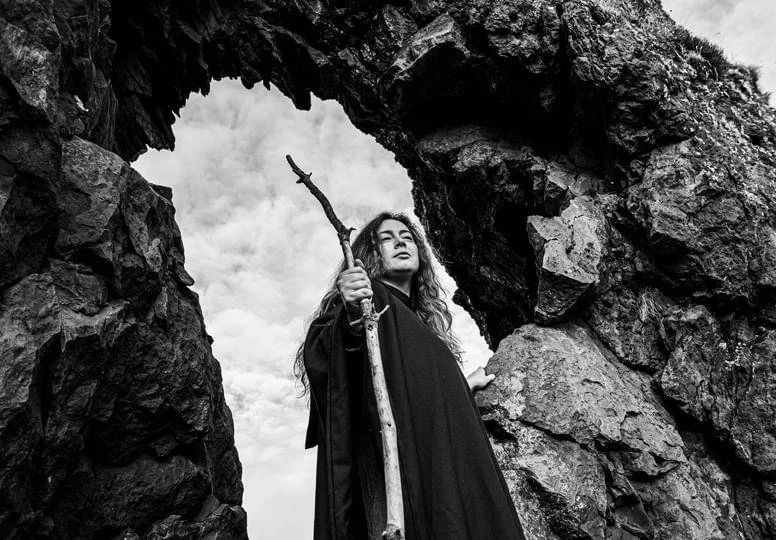
Every time I perform Völuspá or walk it through, I am struck by how much I seem to travel to another place and time, and by the stillness in the audience in response - it really has the power to transport, and feels very like a ritual. Perhaps it helps that I do it in costume, with my own staff (the equipment of any good völva) which I found on a hike in the woods, and now lives next to my sofa.
Peek
My first Norse-inspired poem, about how a developing body can feel like the void Ginnungagap, was published in the TLS in 2021 (https://www.the-tls.com/literature/original-poems-literature/ginnungagap-clare-mulley).
An article on my first project performance will be published in a Trivent collection in summer, and there is a Youtube recording here (please bear in mind it’s mainly live, and the sound quality can vary :
You can also read a review of the performance here: https://www.churchtimes.co.uk/articles/2023/30-june/comment/columnists/paul-vallely-voice-of-prophetess-speaks-to-the-soul
Prompt
Focus on a story or figure from medieval literature that has inspired you in some way, and then go for a walk (literally) with it in a spot where you can think loosely. Try to tune into what emotions it evokes in you, and why. I would then advise pacing along or sitting in a suitable spot, while trying out phrases in your head or out loud, to see how they feel. When you are ready later, try to write non-stop for two minutes, capturing the main phrases and sounds you came up with. These may be the building blocks for a poem.
If you would like to experience live writing tips, follow me on Instagram (@clareify). I am currently (in early April 2026) on a poetry residency at Charles Causley’s house, Cyprus Wells, and will be posting regularly with ideas!
