
Meet a Medievalist Maker: Julia Salkind
“Meet a Medievalist Maker” is an ongoing series of blog posts introducing our members and the work they are doing. Each post is organized around our Four P’s: a project they are working on (or have completed but want to highlight); their process: medium, etc; a peek at their work: images or excerpt; and a prompt: instructions for a brief exercise they share to allow readers to experience/explore their process. Would you like to write a post introducing yourself and your work? Send us an email!
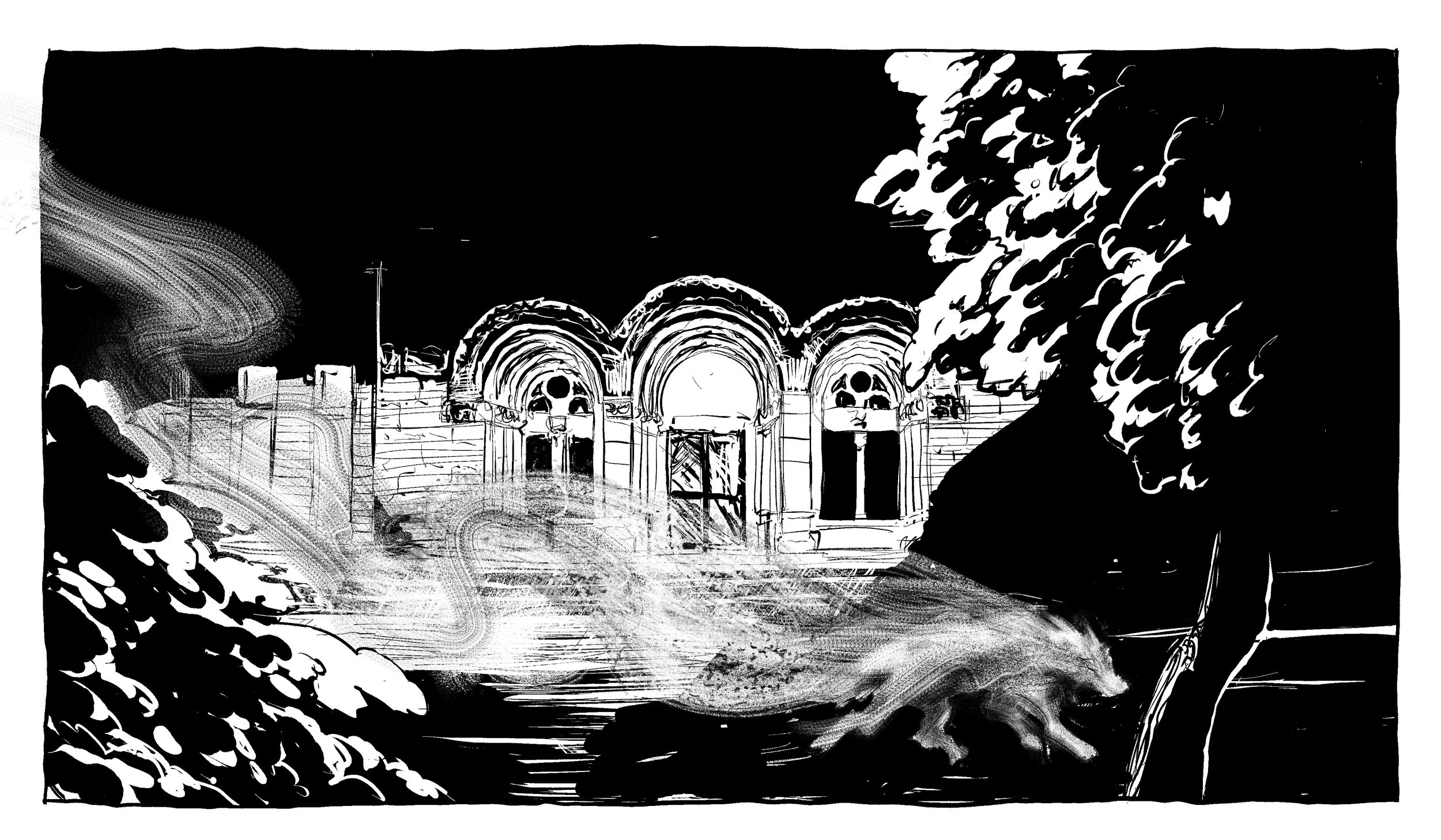
Hello! I’m Julia Salkind and there are two facts I know: I love Marie de France’s werewolf lai, Bisclavret, and I’m not a skilled artist. Michael Albrecht, my brilliant cartooning buddy, also knows two things: he loves werewolves and Marie’s Bisclavret, and he is indeed a skilled artist.
Project
While my research mainly focuses on sexual violence within late medieval literature — not a cheery topic, but a necessary one — I find a lot of comfort in finding ways we can learn about different areas of disability studies from various monster tales. With Bisclavret, I love thinking about how we can read it as a healthy model of listening to narratives of sickness or disability. Though I’ve presented these ideas in conference papers and hopefully in a future publication, I would also like to share them with the world beyond academia, a task for which comics seem particularly well suited. But how do I, someone whose artistic abilities start and end with stick figures, make these ideas approachable and appealing?
At the “Cartooning the Medieval” event held at Chicago’s Newberry Library, a workshop designed to “bring medievalists and cartoonists together to see what would happen,” I found an answer to my questions. Over two days, I met and interacted with many magical cartoonists who shockingly thought I was cool, too (a rare treat for a poindexter like myself). One such cartoonist I met was Michael.
Michael’s art spoke to me the second I saw his work bloom onto the page during one exercise in which we spontaneously created a “medieval” story inspired by manuscripts the Newberry provided (ended up being about a rabbit saint that cooks himself . . . stayed tuned for that comic). I was entranced by the creativity behind his stories and the way his artistic style felt plucked from my own head. I even thought to myself, “If I could draw, I would want to draw like him.”
When Michael approached me and said he would love to collaborate, I was thrilled, and thus the project was born: a modern re-telling of Bisclavret set in Chicago putting ideas about disability studies, accommodation, and accessibility on display.
Michael thinks in a similar vein as I do about our beloved Middle Ages. His interest in it grew from everyone’s favorite Monty Python and the Holy Grail and the delight that Arthurian topics bring. Therefore, it only made sense for him to collaborate on Bisclavret with me to further his connection to the Middle Ages, while “having a blast drawing a big, freaky wolf.”
Michael sees Bisclavret as one of only a handful of werewolf stories in which the “monster” is unquestionably the hero. For him, it’s a story in which the rejection of a person’s perceived otherness is unjustly treated as a heinous thing. Ultimately, and I could not agree more, Bisclavret’s tale is a deeply moving one and a reminder that kindness can be found in a part of the Middle Ages so often misremembered for cruelty.
Process
As mentioned earlier, I am by no means a cartoonist though Kristen might have started to convince me otherwise at “Cartooning the Medieval” (I am not yet brave enough to show the botched Margery Kempe I doodled)! My part of the project was much more writing intensive as I drafted the script for the comic, incorporating three elements: the lai itself, my research, and the ideas of acceptance, accessibility, and care that drew me to my views on Bisclavret in the first place and made the text feel modern.
I knew we wanted to set the story in Chicago as not only do we love the Newberry, but we wanted our story set in a disability-accessible city. Chicago transit systems are far more up to ADA standards than the rest of the country, and areas we feature in the comic, such as Lincoln Park and their excellent zoo, are highly accessible for those with a wide range of disabilities and assistive devices. Overall, we wanted our Bisclavret to take place in an environment that people recognize, love, and can be a part of.
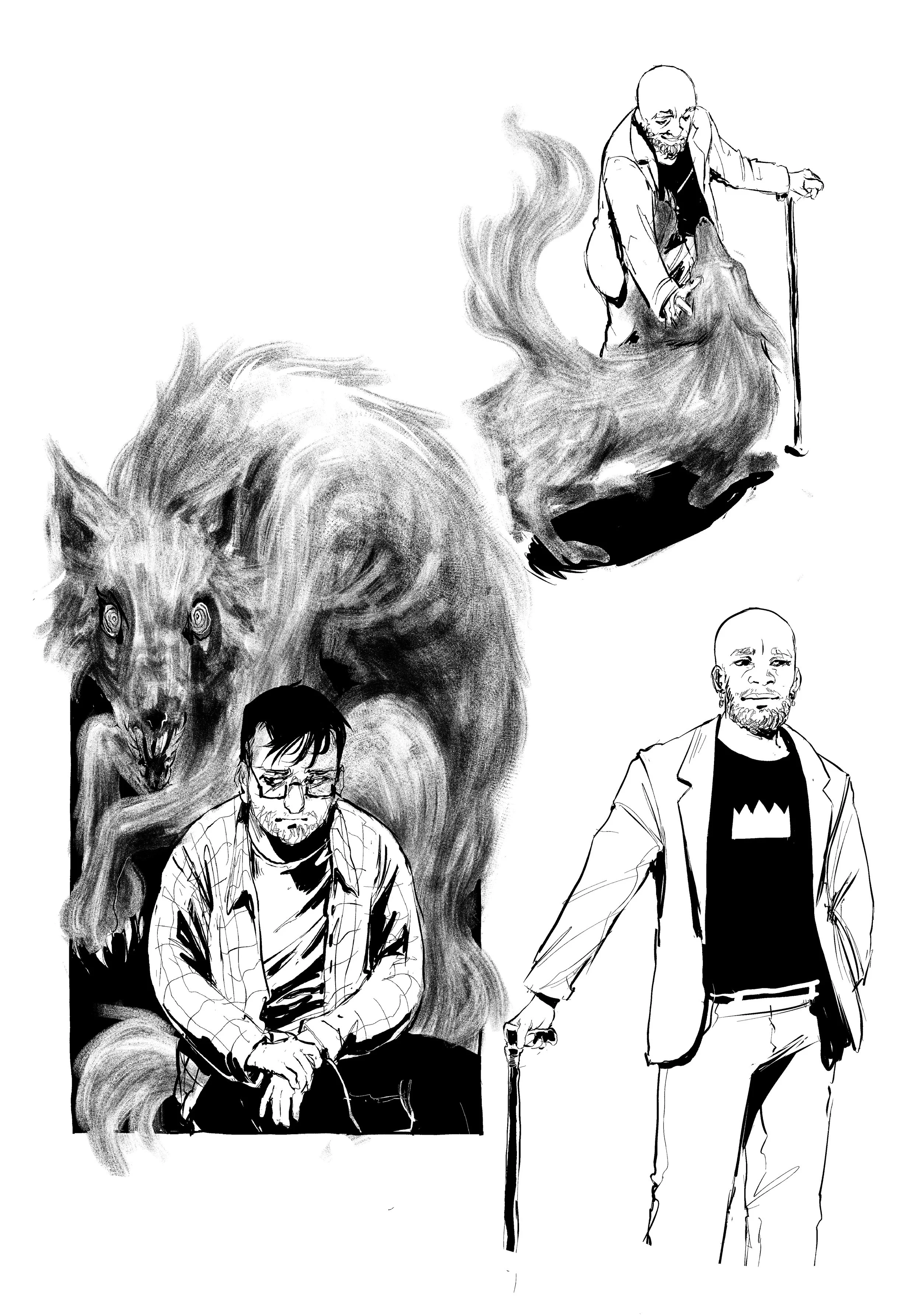
I wanted our characters to feel like people you’d see around Chicago while also displaying a variety of disabilities. Bisclavret himself has some sort of invisible disability. We signal this through the bags under his eyes for his fatigue, and through environmental cues, such as a massage cane and heating pad in his apartment to indicate he’s dealing with something we may or may not recognize as chronic pain. Other characters have a walking cane, hearing aids, a medical response dog, and shaded glasses to indicate photosensitivity or even blindness. These designs are intended to help our readers without disabilities think about people in their communities and our readers with disabilities to feel seen.
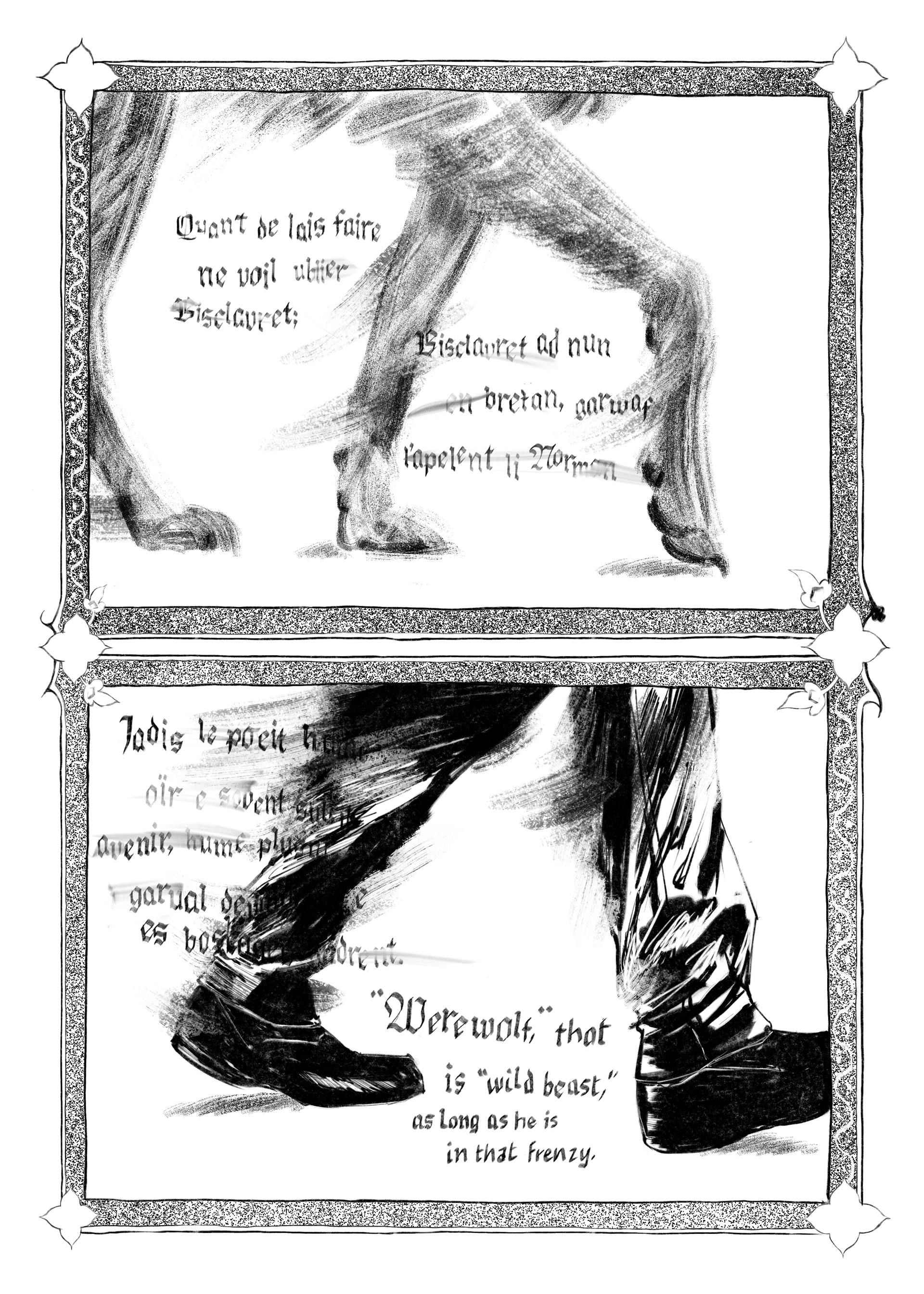
Michael is naturally drawn to working in black and white, and the moody tone he sees in the Bisclavret’s palpable distress lends itself well to ink brush visuals. He decided to portray Bisclavret’s lupine form with a textured dry brush to give it an otherworldly appearance, emphasizing his “otherness,” taking inspiration from horror art (go see hisotherwork, it’s stunning).
Peek
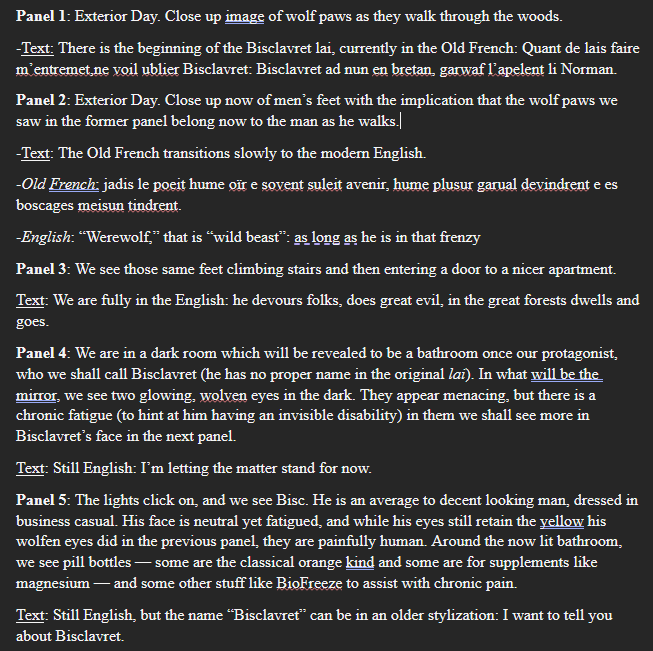
Here are parts of the script so you can see the before...
And here are just the beginnings of the amazing after!
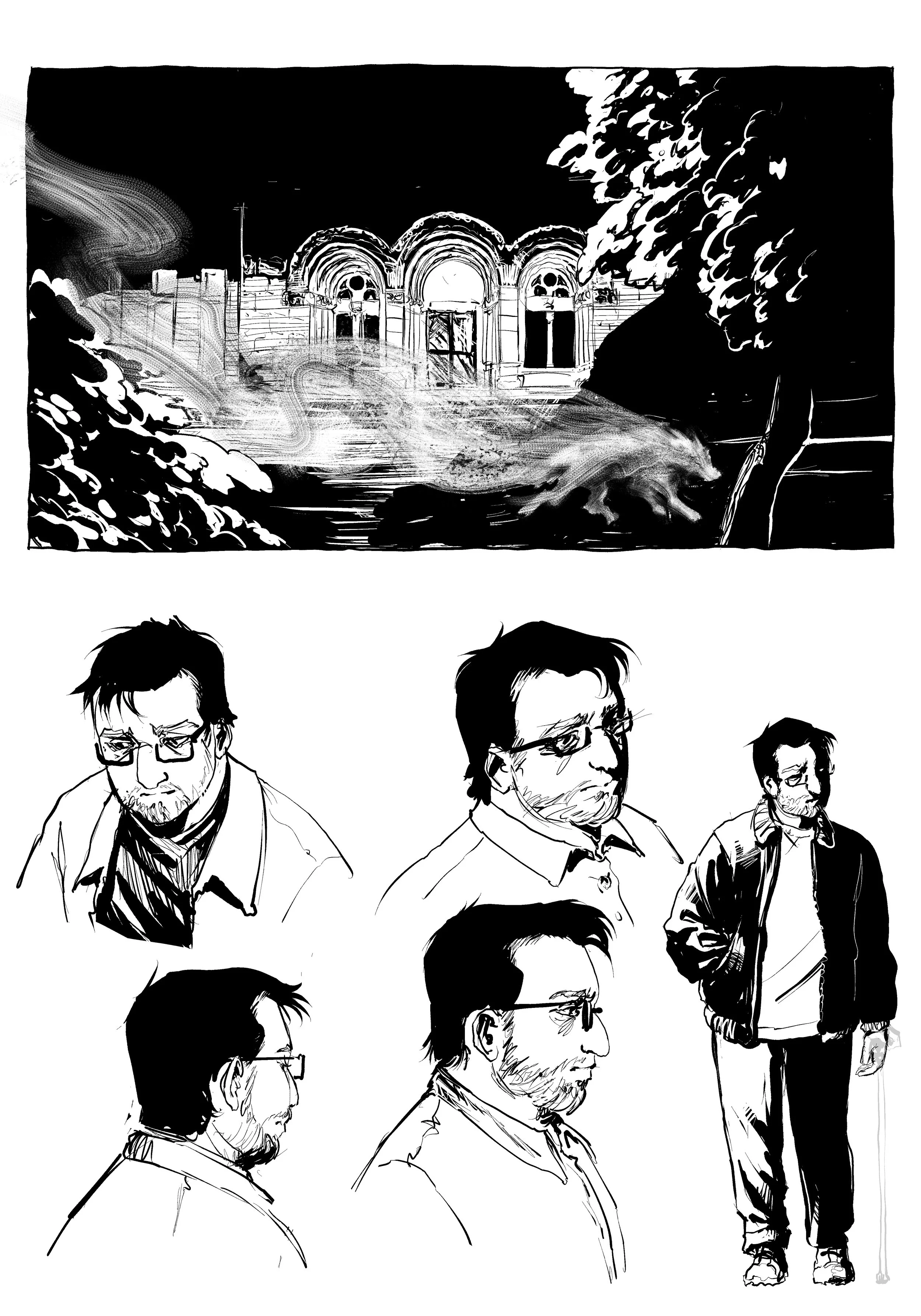
The borders he draws are inspired by those found around Marie’s likeness in BnF Ms-3142 (Recueil d'anciennes poésies françaises) on folio 1r. The panels’ lettering also comes from that same folio, though we wanted to make it a little clearer for all readers. As those of us who do grapple with paleography know, your head swims after looking at lettering, and that’s not a pain we wanted to inflict upon anyone.
The comic will be about 31 pages and will hopefully be completed this June! We want to have it available digitally and in print to increase accessibility for a wide range of readers and to stick with the values we convey within our comic.
Prompt
Think of a piece or element of medieval literature you that really grabs your attention even if you don’t know why it speaks to you. Sit and think on it for a few minutes. It can be helpful to put pen to paper. Let your ideas flow through cartoons, diagrams, words, or however you process your thoughts. Allow the following questions to guide you: how do you connect to it, what do you see in it, and why do you think it came to you during this exercise?
Then, go ahead and put your cartooning hat on! Grab whatever you feel artistically drawn (pun maybe intended) to. I know I love a really inky pen and some thick paper, and Michael prefers his tablet and digital pencil, but you can use anything you want ranging from crayons to paint to a golf pencil. Start drawing (or start scripting)! I recently did this exercise with the General Prologue in the Canterbury Tales, and I thought about how I would want to see my Wife of Bath presented in different panels. I focused on each part of her self that’s described, ranging from her gapped teeth to her stunning red stockings. I did the same when considering about how we wanted to start our Bisclavret comic, thinking about how I wanted it to be clear that he lives two lives. To show that, we separated his two forms into separate panels and had the words also transform as they’re translated from Old French into modern English. Working through a process like this helped me realize that I might actually be a comics person after all.
Once you’re finished, sit back and look at your creation to see how you’ve married your answers to those questions to your selected medieval passage or text.
