
“Meet a Medievalist Maker” is an ongoing series of blog posts introducing our members and the work they are doing. Each post is organized around our Four P’s: a project they are working on (or have completed but want to highlight); their process: medium, etc; a peek at their work: images or excerpt; and a prompt: instructions for a brief exercise they share to allow readers to experience/explore their process. Would you like to write a post introducing yourself and your work? Send us an email!
I must start with a confession: I am not strictly a medievalist. Most of my work is inspired by the 1520s and 1530s – but what are a few decades between friends?
I am a textile artist with a small studio in West London, UK, with an archive-based creative practice. I trained as a film historian, and wrote my PhD thesis about the early career of British film director Maurice Elvey and his biographical propaganda films made during the First World War. But I read Hilary Mantel’s Wolf Hall in 2009, started stitching work inspired by her Thomas Cromwell Trilogy in 2014, and, in 2020, decided that my place was with Cromwell. Hilary and I corresponded about my textile work; she was very generous and supportive of it; and not a day goes by now without me wishing I could show her how Stitching Cromwell develops. I think I will be stitching Cromwell for as long as I am able.
I write about my creative practice at https://thethreadofhertale.substack.com/ and at www.stitchingcromwell.com
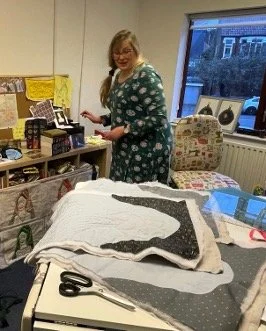
Caught mid cut in my studio.
Process
I work entirely by hand. I’m not trying to reproduce 16th century stitching techniques or restrict myself to 16th century materials: the novels that inspired me were written in the 21st century, and my work is being created in the 21st century also. It’s simply a matter of preference: I can’t get the effect I want by machine, and I don’t enjoy machine stitching.
I tend to stitch to audiobooks – the Cromwell Trilogy read by Ben Miles, who played Cromwell on stage, is my go-to and is usually playing somewhere in my vicinity. Sometimes I will hear a phrase will trigger an idea for a piece of stitched work, and I work surrounded by index cards that say things like “Don’t forget the map discussion at the end of Wolf Hall”; “Book of Queens”; or simply “Playing cards!!!!”
Place is also important. I enjoy going out “Cromwelling”, or visiting sites associated with him. Obviously, there are tourist sites like Hampton Court and the Tower of London, but there are also ruins like Lewes Priory, or the wall that remains of his house at Mortlake by the River.
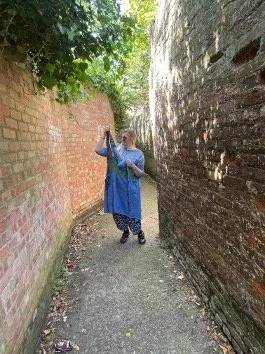
Examining textiles by Cromwell’s wall (at the right of the photograph).
Project
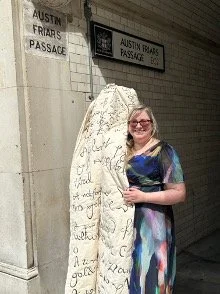
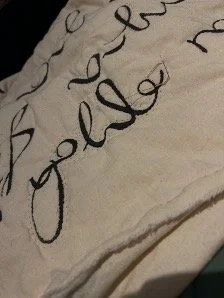
It’s very seldom that I make a piece with which I am entirely happy, but The Cromwell Textile Cloth (2024) is a rare example. I have been spending a lot of time in the UK National Archives over the past couple of years, going through paperwork associated with Cromwell. Not many letters from Cromwell survive, but lots of letters to him are extant, as are legal and state papers drafted by him. I was overjoyed to see a list of textiles, in his untidy scrawl, written in 1528. It related to a legal case he had taken on where the ownership of valuable fabrics was contested. I created a quilted representation of this list – which exemplifies Stitching Cromwell: a piece of stitched work representing Cromwell’s hand, when he was writing about textiles, about which he was knowledgeable. To reflect his humble beginnings, the piece is made from unbleached calico, but to reflect his love of luxury the interior wadding is expensive silk. To to reflect his discretion, the only person that knows about the silk – unless I tell you – is me.
When the piece was finished, I took it to the site of his house at the Austin Friars in the City of London; he was probably living there when he wrote the original list.
Peek
I’m obsessed with Cromwell’s correspondence – there was just so much of it, and it is incredibly wide ranging. I am working a long-term project to create a textile representation of what his biographer Diarmaid MacCulloch called his “in tray” – and it’s a mammoth undertaking. I’m making a stitched and inked summary of every surviving letter sent to him, demonstrating the amount of business he dealt with and how it grew year on year.
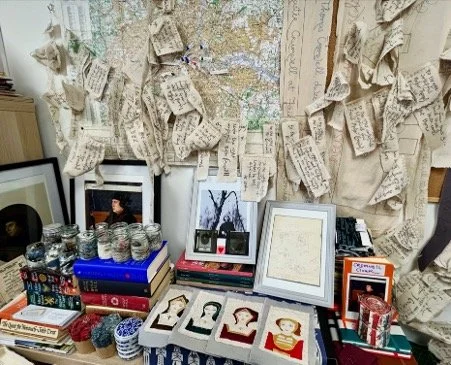
Letters to Cromwell from 1527 and 1528 hanging in my studio.
I like to see how the original letters when I can, and am particularly interested in how they were addressed. Master Secretary or My Lord Privy Seal? Master Cromwell or Lord Cromwell? These addresses illustrate his rise and rise – and deciphering those addresses has increased my familiarity with 16th century handwriting styles.
The textile letters are backed up by an extensive database. I record each letter, who wrote it and when, its address, a summary, and whether there was a gift enclosed. I think this project will take the rest of my life to complete, and I am happy with that thought.
A bonus peek at a brewing project: I want to stitch the names of monks and nuns who were pensioned off at the Dissolution of the Monasteries. I’m currently going through original pensions records, logging names and locations. I’m not yet sure how this piece will materialise, but I want to remember and honour the names of these men and women whose lives were turned upside down when their religious houses closed in the 1530s.
Prompt
Working this way is labour intensive – especially if, like me, you like to collect a huge amount of data on the way. But to sample this approach, you could choose just one document that interests you and use that as a starting point.
If it is possible to see the original, that’s wonderful – the ink and paper still carry meaning – but we live with a treasure trove of digital archives (for example, Henry VIII’s love letters to Anne Boleyn are in the Vatican, but can be seen online). As long as you can view a clear image, you can examine the text, the shape of the letters, the meaning of the words and the use to which they were put. And let your imagination take you forward. You never know what the archives will spark.
Thank you for this fascinating post, Lucie! You can follow Lucie’s work on her Substack, her Stitching Cromwell website, and her Instagram.
