
Meet a Medievalist Maker: Susie Campbell
“Meet a Medievalist Maker” is an ongoing series of blog posts introducing our members and the work they are doing. Each post is organized around our Four P’s: a project they are working on (or have completed but want to highlight); their process: medium, etc; a peek at their work: images or excerpt; and a prompt: instructions for a brief exercise they share to allow readers to experience/explore their process. Would you like to write a post introducing yourself and your work? Send us an email!
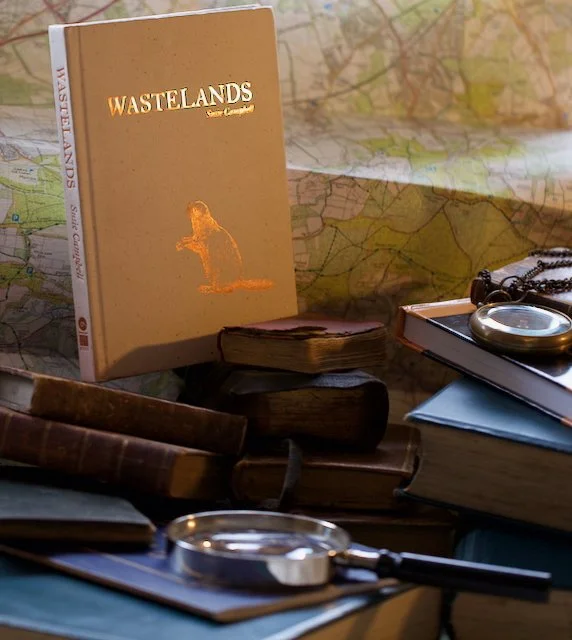
The frost is thick on my windowsill as I write this. Much of my practice involves outdoor fieldwork which I love – but today I am quite pleased to be indoors in the warm, my two dogs snoring and sighing as they dream. As I sit here at my desk, I am reflecting on the ongoing medievalist aspects of my work. They might seem at odds with my love of experimental and avant-garde poetic forms, but they are actually at the heart of my poetic engagement with place. Several of my poetry publications engage explicitly with the shaping presence of medieval and prehistoric pasts within present places: Tenter (Guillemot, 2020) develops its poetry out of unhealed cultural wounds resulting from the 1066 Norman Conquest, framed by the making of the Bayeux Tapestry, while The Sleeping Place (Guillemot, 2023) stages textually multiple and shifting pasts suggested by the archaeological excavations of a Saxon burial site discovered near my family home. My current project, the recently published Wastelands builds on this body of work, engaging with medieval tropes of pilgrimage, quest, and wounded lands, partly as filtered through the lens of nineteenth and twentieth-century writers but also through direct engagement with medieval literature: de Troyes, Chaucer, the ‘Gawain poet’, Malory etc. I have written at length elsewhere about Wastelands and my archaeological and archival practices, and about my navigation of extended textual spaces in the long prose poem (Long Poem Magazine, issue 34), and so here I am only going to tease out here these medieval aspects.
Project
My Wastelands project started out as a deconstructive approach to the Victorian Ordnance Survey’s reductive rendering of an important network of medieval and prehistoric pathways as a single, totalised, and mythologised route: ‘The Pilgrims’ Way’ (Winchester to Canterbury). This persists on contemporary OS maps of my local area of Surrey, overlaying a multitude of ancient sacred ways with a notional and unified ‘heritage’ way. Initially, I was mainly interested in alternative ways of envisaging sacred landscape as an interplay across a network of ritual or ceremonial sites as opposed to the linearity of a unified Pilgrims’ Way, questioning the latter’s division of value in place-making between high-value heritage sites and low-value or ‘othered’ sites (such as wastelands). Much of my early work involved thinking not only about quest schemas and pilgrimage routes, but also about the persistence of older pre-Christian mythologies/beliefs into later renderings of the landscape. One of my first conversations with Laura (Guild co-founder Dr Laura Varnam) was about the ‘Green Chapel’ as just such a possible remnant! However, the discovery of a literal ‘wasteland’ in the form of a landfill site at the heart of this landscape shifted the focus of my project to include an ecological engagement with issues of land exploitation and environmental depletion. And so there are many ‘wastelands’ in my project: literary, mythological, psychological, cultural, as well as ecological, all entangling with each other through layerings of past and present.
Process
My process is deeply involved with the problematic histories and geographies of my own local area in the southeast of England, and with how the prehistoric and medieval ‘stories’ of this part of Surrey continue to inflect contemporary narratives involved in place-making. I am interested in how spaces are processual, constantly changing, and in the challenge of how to stage in poetry the co-existence of different and varying pasts of a site. In Wastelands, this led me to explore alternative ways of navigating and mapping the landscape, charting these possible pasts as well as the absences and silences of what is no longer physically there – although still present as a shaping force. Wastelands opens with the long poem ‘Stein’s Snark’ which reimagines the thirty-two bearings on a compass as a layering of historical pathways criss-crossing each other, so there are many different Norths, and many Souths in this poem: prehistoric, medieval, modern, and contemporary. Through a pattern of repeated words and sounds, the poem reknits these multiple layers into a new set of compass bearings for navigating a deconstructed Pilgrims’ Way. My textual process here was inspired by literal spinning and knitting, forms of making deeply inscribed in this place which includes many of the sheep drove routes and traditional fair sites which supported the important medieval wool trade of this area.
Another long poem in the book, ‘Dog Pilgrim’, deconstructs map coordinates used by the OS National Grid to make space for what has been destroyed or lost by quarrying and landfilling a site of Mesolithic, Neolithic, and Bronze Age, as well as medieval, importance: traces of burial mounds, broken standing stones, and even a hint of a lost Green Chapel are scattered in fragments across the page along with ghostly echoes of medieval and modern texts about ‘wastelands’. Accompanying this text poem are visual and textile poems based on my excavation of waste materials from the landfill site in order to make them into ritual and performance objects. The making of poetic ritual objects is an important part of my process as a way of connecting with what has been lost as well as with dangerous emergent energies.
Peek
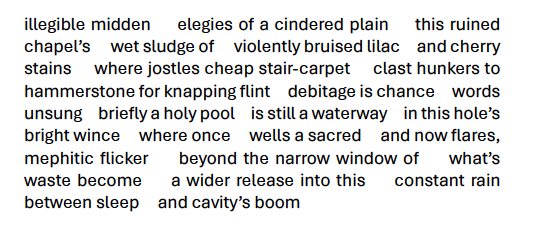
It’s hard to share short extracts from Wastelands as so much depends on the way the text is patterned and placed across the page but here are two edited fragments from ‘Dog Pilgrim’ which I hope give some sense of the work. The first is a glimpse at the jumbled ‘archaeology’ of a landfill site situated on top of a much older and once sacred landscape:
And the second plays with fragments of some of the medieval texts which echo through Wastelands:
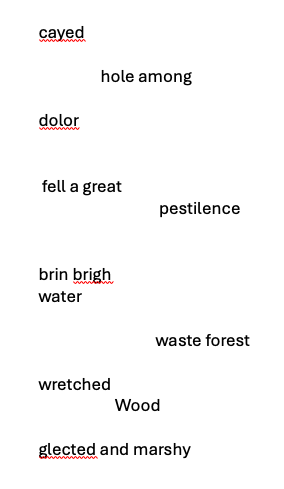
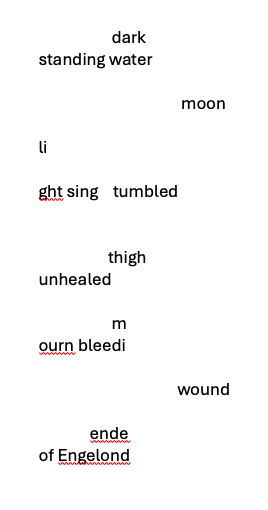
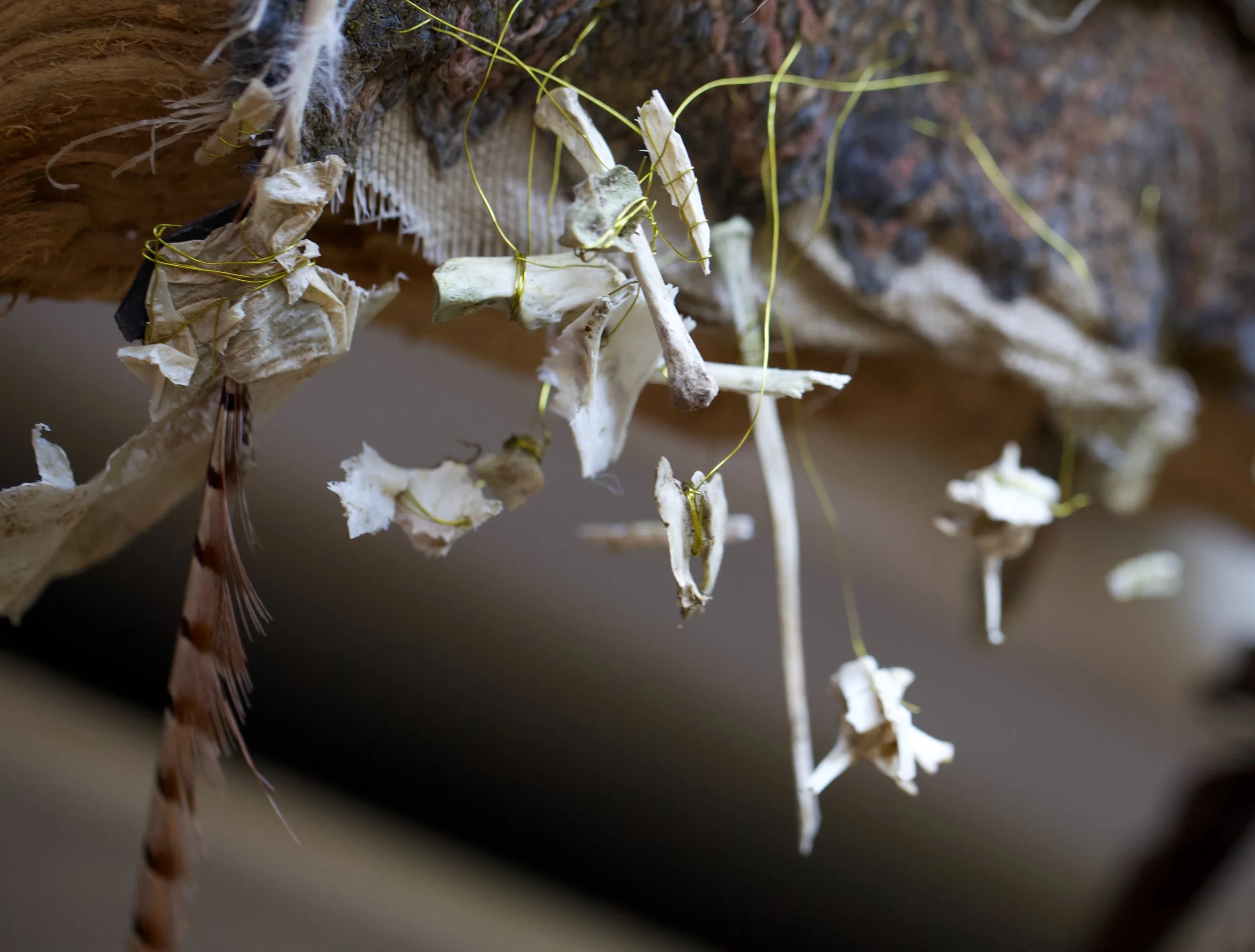
Ritual object made with waste fabric, bones, feathers, plastic etc recovered from landfill. (‘Hodening’ from Wastelands).
Prompt
1. Collect together half a dozen scraps or items that have some association for you, connected perhaps with a particular memory, feeling or place. The items could include: textiles (thread, ribbon, fabric), packaging materials, postcards or images, small souvenirs or found items.
2. Join these items together in the form of a ritual object or ‘jewel’ (e.g. a bracelet, a pendant, a prayer-nut, a votive object, amulet, etc). You could connect the items together by sewing, or through collage techniques, or by placing them inside a small container or box. As you connect your items to form your ritual object, you might consider their emotional, personal, or wider resonance.
3. Once the object is complete, spend some time observing and reflecting on it. Jot down some notes and use these ideas to compose a short text to accompany your newly created object, this could be in poetry or prose. You could write a charm, a chant, a short poem, an invocation. This text could sit alongside your object or even be deconstructed for inclusion on or inside your object.
4. Allow some time to pass (a day, a week, a month, perhaps even hide your object!) and then return to it and think about how its resonances might have changed.
