
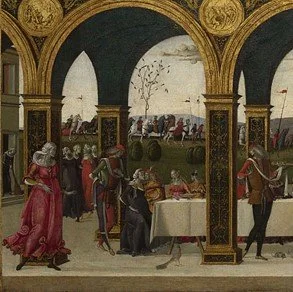
“Meet a Medievalist Maker” is an ongoing series of blog posts introducing our members and the work they are doing. Each post is organized around our Four P’s: a project they are working on (or have completed but want to highlight); their process: medium, etc; a peek at their work: images or excerpt; and a prompt: instructions for a brief exercise they share to allow readers to experience/explore their process. Would you like to write a post introducing yourself and your work? Send us an email!
Hello medievalist makers! I’m Sara Fredman and I’m thrilled to be here. I trained as a medievalist and now write for a living in an academic setting while writing for my sanity in a home setting. All three of those identities led, somewhat circuitously, to the existence of Griselda is Dead, and Also Her Patience, a novel that reimagines Chaucer’s “Clerk’s Tale” as 21st century memoir. I am looking for a good home for this novel so please be in touch if you know anyone interested in medieval heteropessimism and the power of storytelling.
Oh, and I also publish Write Like A Mother, a Substack on process and parenting, if you’re into that sort of thing.
Process
This book came about because I was mindlessly scrolling through Instagram when an ad popped up for a Netflix show called Griselda. I would soon come to find out that the show stars Sofia Vergara as Griselda Blanco, a notorious Colombian drug lord, but for a hot second my mind re-entered the chat and said, “Sweet, someone’s finally making a show about the Clerk’s Tale.” Later disabused of the notion that streaming services are wisely plumbing the depths of the premodern literary canon, I decided to be the Griselda novel I wished to see in the world.
Project
Griselda is Dead, and Also Her Patience is grounded in my obsession with motherhood and storytelling. Like Madeline Miller’s Circe and Percival Everett’s James, the book reconsiders an existing character, the most obedient wife in literary history, and gives her a voice. In Griselda’s hands, her story becomes a reflection on marriage – how we get into, and sometimes out of, this vexed matrix of vulnerabilities – but it also comes to question the very enterprise of retelling old stories for a modern audience. What are we looking for when we pick up a “reimagined classic” or a “bold and subversive retelling” of a centuries-old tale?
Griselda's story, of a wife plucked from poverty and repeatedly tested by her noble husband, has been told over six centuries and across genres, including more than one play, four operas, several ballads, a number of paintings and illustrations, an early COVID short story by Margaret Atwood narrated by an alien, and even a puppet show. Each retelling grapples with a woman behaving exactly as women have always been taught to behave – patiently, steadfastly, obediently – to horrific effect.
Griselda is Dead, and also Her Patience receives this long tradition and transposes it into the voice of our time: a woman finally in charge of her own story, like Sarah Manguso's Liars with 800 years of hindsight. Was Griselda, in fact, “unconscious of any want,” as Petrarch claimed? Was it true, as Chaucer’s Clerk told his fellow pilgrims, that “no lust coursed through her heart”? And did she truly remain constant, inside and out, as her husband took one baby from her, and then another? When he tried to replace her with a newer, younger wife? What results is a meditation on power and desire that asks whether what was true for women for most of human history still dictates the shape and scope of our lives and thinks deeply about what it has always meant to hear stories and read literature as a woman.
Peek
(Excerpt from ‘Griselda is Dead, and also Her Patience’)
I know that when you bring an old story into the present, it is not just to revise the uncomfortable and bear the unbearable. There is another comfort that comes when you let the abused triumph or turn a pitied simpleton secretly wise. When you do this, you are also transforming yourselves, narrating your own time as different, better, redeemed. That old world, that ancient time, they were bad, benighted but for this one hero. When we pull these characters into our time, we are also putting distance between ourselves and the way the world used to work. But what if the world is not so different than how it once was? What if you are more like me than you want to believe? What if the women of all those stories my mother told me, the ones you are so quick to revise, have something to teach you about the truth of moving through the world in a body like yours?
Falconry, as Walter was fond of telling me, is about training something wild to feel free. A falconer takes as his subject a giant majestic bird of prey that has been captured, or has lived its entire life in captivity, and it is his job to reawaken his charge to its wildness, its razor-sharp instincts, but only toward the falconer’s goals and desires.
And always, always to return. The properly manned falcon flies free but never fails to return to its master.
Do you understand where I’m going with this?
Who, aside from Griselda, Boccaccio writes, would have suffered, not merely dry-eyed, but with a cheerful countenance, the cruel, unheard-of trials to which Gualtieri subjected her?
As if Boccaccio knows what lurks behind the cheer of the women he knows. Cheerful countenances are our currency, the way we buy our little luxuries, our small moments of freedom, sometimes our survival. Often it is how we ensure the wellbeing of our children, how give them what we know they need.
Chaucer understood this. He put my tale in the mouth of a clerk because when a clerk tells a story, he knows it will do something to the person listening to it; he knows they will take it as an example. I wish my wife at home could have heard this tale, one of the Clerk’s listeners exclaims the moment the story is done being told.
The trained hawk is the beautiful message that conceals the messiness of a real woman. You can teach a woman to stay or to return but she knows it is day even when you lower the hood over her head. Even if she can convince you she believes it is truly night.
Prompt
A fun thing to do is to take any literary character you find abhorrent or difficult to understand and think about what would need to be true for that character to earn your sympathy or become more relatable. Write a personal essay in the voice of that character, telling their story, and then reflect on the kinds of stories we think of as humanizing. Extra credit for thinking about how those humanizing stories may differ from medieval conceptions of humanity and approaches to evoking sympathy.
