
Meet a Medievalist Maker: Tim - Siglum Calligraphy
“Meet a Medievalist Maker” is an ongoing series of blog posts introducing our members and the work they are doing. Each post is organized around our Four P’s: a project they are working on (or have completed but want to highlight); their process: medium, etc; a peek at their work: images or excerpt; and a prompt: instructions for a brief exercise they share to allow readers to experience/explore their process. Would you like to write a post introducing yourself and your work? Send us an email!
My name is Tim, I’m a professional calligrapher and amateur Youtuber working in Boston. My current video project, working title “Yde & Olive: Recreating a Medieval Epic”, adapts a medieval chivalric tale in song and calligraphy, and explains some of the history behind it.
Project
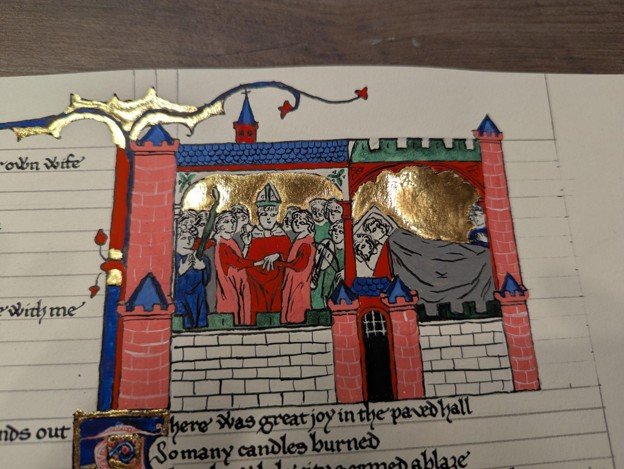
Above: a proof-of-concept version of the Yde & Olive miniature, with some calligraphy and marginal decoration.
Yde & Olive is a fourteenth-century chanson de geste about a transgender knight. Chansons de geste were epic poems that straddled the divide between oral and written literature: those that survive come down to us in manuscript or printed versions, but in their time they were sung by minstrels. Yde & Olive survives in multiple versions, but the one I’m focused on is from Turin L.II.14, a beautifully illuminated manuscript produced in 1311.
The Turin L.II.14 version was recently translated by fellow GuMM member Mounawar Abbouchi. She is the foremost scholar of Yde & Olive studies—and, to my great delight, she agreed to edit my video script. My aim with this project is to tell the story of Yde & Olive, and then tell the story’s life outside the text: the text as a musical performance, as a physical object on the page, and as a feature of fourteenth-century life.
Process
To do this, I’ve pursued several approaches in parallel:
I wrote a shorter, 300-line summary of the 1056-line original poem
I copied out that new poem as an illuminated manuscript
I performed the poem as a song
I talked about the creative choices I made doing the above, and the historical basis for making them
I talked about the history of the poets, scribes, minstrels, audiences, etc. that made the original story, and passed it along through the centuries.
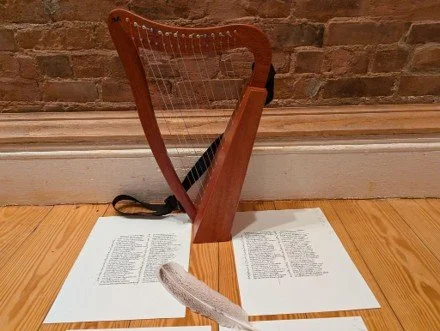
Above: Two of the six pages of the 300-line summary poem, the harp on which I perform it, and the turkey quill I used to write it.
The manuscript creation proved unexpectedly easy. The original manuscript is fully digitized. Very unusally, the miniaturist who illustrated Yde & Olive is both known to modern historians and is fairly well-studied. The anonymous miniaturist is named “the Master of Sainte Benoite” in the scholarship, after their masterful cycle of 52 illustrations for the Life of St. Benoite, all of which survived intact. So, even though the Yde & Olive miniature has suffered some damage, I learned enough by copying the artist’s Sainte-Benoite miniatures to be able to reconstruct the damaged parts with a great deal of confidence… and learn how to illustrate other episodes from the Yde & Olive story in the same style.
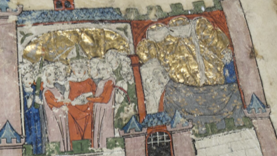
The original, fire-damaged miniature for “Yde and Olive,” from Turin L.II.14, f394vb
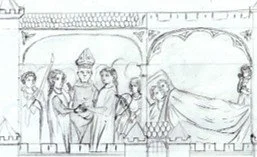
My pencil study, aiming to reconstruct the damaged half.
The musical re-creation was much more difficult. We know that chansons de geste were sung, but very little besides that. There are only a few tantalizing bits of written evidence that could help a modern person perform a chanson de geste. A few brief scraps of notated melody survive in other contexts that originate (probably) in the chanson de geste tradition.
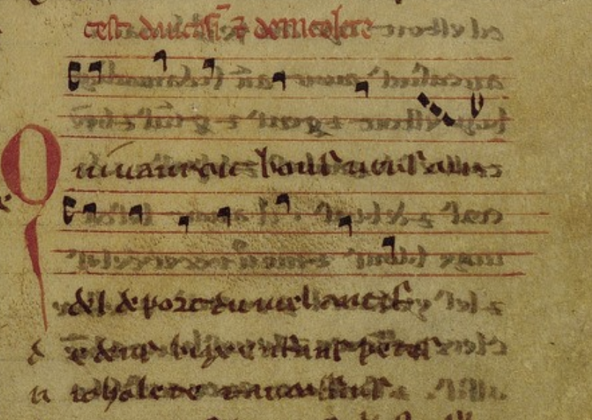
Above: Musical notation from “Aucassin et Nicolette,” BNF MS Fr. 2168, f70r. Arguably, this is one of three surviving witnesses to the musical tradition of chanson de geste. I say “arguably” because each of the three has strong arguments against it.
There’s very little to go on, but not nothing! Multiple other performer-scholars (Linda Zaerr, Antoni Rossell, Paul Bracken) have assembled those scraps into complete performances. I was able to stand on their shoulders and build a musical reconstruction of my own, one that fits my own strengths and limitations as a singer and storyteller.
Consequently, the full video will comprise of several parts:, I will show my manuscript, sing my musical version, and explain the artistic choices I made when making them. That’s probably about a third of the full project. The other two thirds are social history: who wrote this story, who performed it, who read it, who listened to it, and what it meant.
“What it meant,” in this case, includes literary meaning, but the question also extends beyond this. Yde & Olive is a very transgender story. So, what did it mean for a very trans chanson de geste to exist in fourteenth-century France? Well, for one thing, it meant that someone paid a highly-skilled team of scribes to make at least one copy. What do I mean by “highly-skilled?” In the video, I’ll go over some of the specific skills required, and present some contemporary scribal contracts to give an idea of the pay scale. And what would it mean to be paid that much? To give context, I’ll show the pay scales for other professions, and say what you could buy with that money, and how long you could live off it.
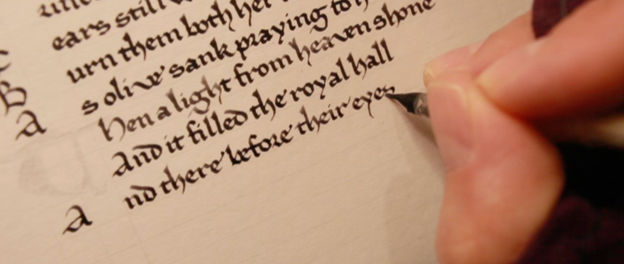
Above: a still from the footage of me writing the shorter, 300-line poem-summary I composed for the video. The majuscule “T” has been sketched out in silverpoint, but not painted in yet.
All these contextual networks build on each other. The material difficulties of life as scribe help me talk about the material difficulties of life as a minstrel. The material difficulties of scribes and minstrels help me talk about the choices they made when they wrote or performed a story. And the magnitude of all those choices gives weight to the fact that Yde & Olive exists in multiple versions—meaning that multiple teams of scribes were commissioned by multiple wealthy clients to produce multiple manuscripts of the story. Furthermore, each written copy implies an unknown number of public performances by minstrels.
And all of that gives context to the choice of story. All these talented people chose to copy, to illustrate, to sing and to memorize this specific story about Yde, who was born to be Princess of Aragon, became a knight, married the Princess of Rome, was saved by a miracle, and lived happily ever after.
And that, in turn, gives extra context to modern adaptations of the story—Abbouchi’s modern translation and analysis, fellow GuMM member Daisy Black’s stage version, and, of course, my own musical/manuscript adaptation.
To see the project when it’s done, you can follow me here. And you can see one of my earlier videos on medieval manuscripts here.
Peek
I will be experimenting with several methods to tell this story visually, but one method I’ll definitely be using is to sync up the footage of my writing calligraphy with audio of me singing my poetic paraphrase, as seen here:
Prompt
Choose a book you’d want to see as a medieval manuscript—don’t worry, you won’t write it! Today, you’ll be a project manager, and you’ll be delegating to your scribal minions.
Look over your text, and determine the major divisions: sentence breaks, paragraph breaks, section breaks, chapter breaks, volume breaks, etc. Rank them from most to least important, and figure out how you’ll communicate them using the decorative elements of a medieval manuscript. Which divisions merit capital letters? Which merit gilded capital letters? Gilded capital letters two lines high? Three lines high? Four lines high with a picture inside? Etc.
Render a quick, sketchy reference page that your loyal scribes can refer to. Don’t worry about making it beautiful—just do squiggly lines for “normal” text, an empty box for a miniature painting, a smaller box for a two-line-high illuminated letter, etc. Do just enough so your scribal minions can see how all the different elements relate to each other on the page.
Finally, assign yourself a calamity. Maybe you’re running low on parchment and need to save space. Maybe your client is cheap, and you need to cut costs by 30%. Maybe your miniaturists died of plague. Now, re-do your decoration schema from earlier to reflect your straitened circumstances. Given the frequency and elaborateness of each decorative element, what can you cut, what can you keep, and what can you downgrade to save resources?
